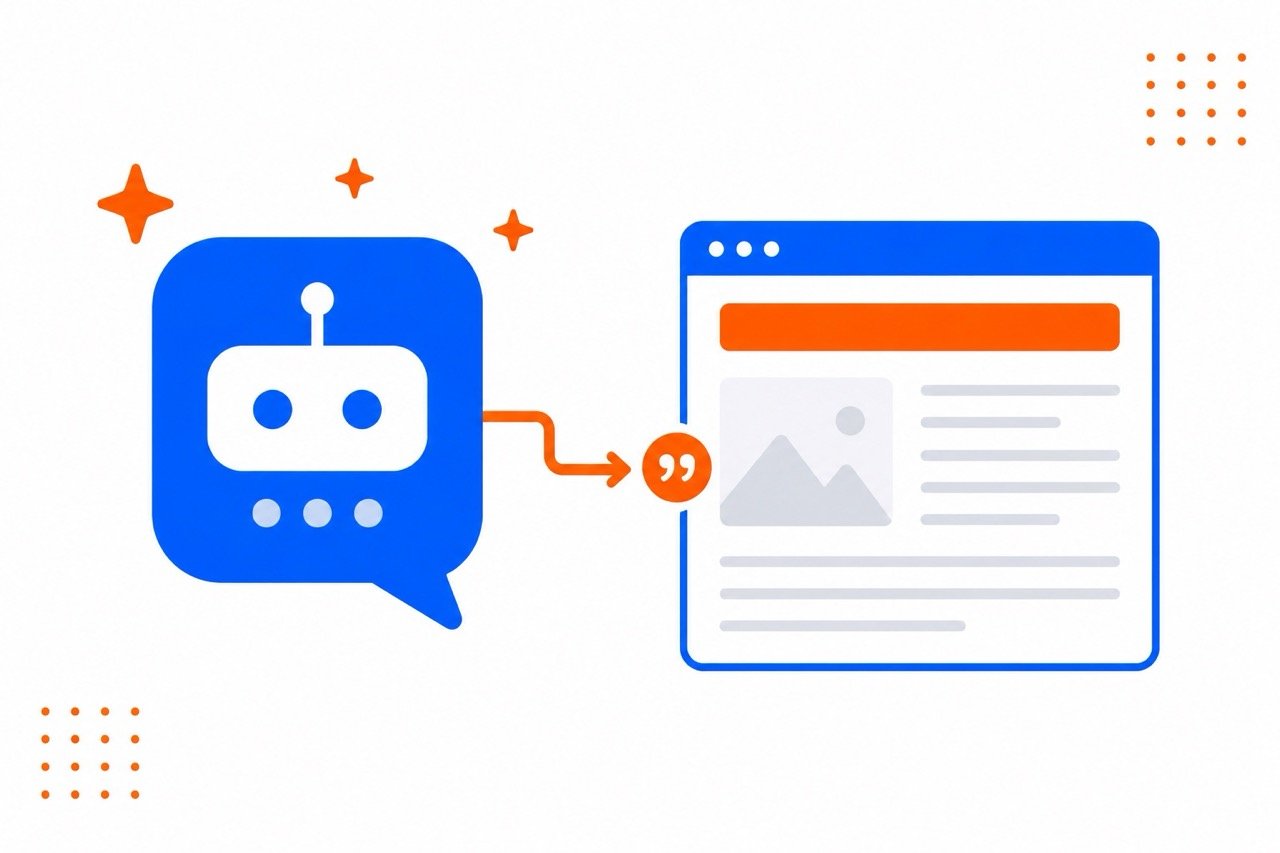
An AI visibility audit shows what ChatGPT, Gemini and Google AI Overviews say about your business today when a buyer asks about your field. I measure whether you are mentioned, in what position, which competitors AI recommends instead of you, and whether the facts it gives about you are correct. I also check the technical side and your content, so you get more than a diagnosis. You get a concrete fix plan, ordered by priority.
Can AI see your business? A one-minute check
Six questions. Nobody sees your answers, so be honest.
What an AI visibility audit is
It is a structured check of how your business shows up in AI answers. A classic SEO audit answers whether Google can find and evaluate your website. An AI visibility audit answers a different question. When someone asks ChatGPT, Gemini or Google, does your name appear in the answer, and if it does not, why not?
I run the audit by hand, asking the real questions your buyers ask. Automated tools are useful for monitoring, but they often ask the wrong questions and do not show how the answer looks to a real person.
Why it is worth checking now
The six pillars of the audit
Mentions in answers
Whether AI mentions you, in what position and in what tone when people ask about your products or services.
Competitor comparison
Who gets recommended instead of you and what share of the answers each competitor takes.
Cited sources
Which pages and websites AI cites on your topic. This is the map of your future mentions.
Factual accuracy
Whether AI gets your prices, address, product range and terms right, or repeats outdated information.
Technical accessibility
robots.txt, firewall, indexing and whether AI search crawlers can see your content without JavaScript.
Content readiness
Whether your key pages give a clear answer, definitions, verifiable facts and schema.
Pillar 1: Mentions in answers
First I put together a list of questions. I build it from your Google Search Console queries, the questions your sales team hears most often, and keyword research. Usually that means 20–40 questions, grouped by your product or service categories.
What I check
- Whether your business is mentioned in the answer and where it sits in the list
- Whether the answer links to your website or only names you
- Whether you are recommended, compared with others or simply listed
- How the answers differ between ChatGPT, Gemini and Google AI Overviews
I measure in clean sessions. Google is checked logged out and in incognito mode, while ChatGPT and Gemini are checked in temporary chats without personalization. That way you see what a new buyer sees, not what AI shows you based on your own history.
Pillar 2: Competitor comparison
For every question I write down every business that gets mentioned. That gives a clear picture of which competitors dominate, which topics you are already strong in and where the gap is largest. It often turns out that AI does not recommend the biggest players in the market. It recommends the ones other people write about the most.
Pillar 3: Cited sources
Google AI Overviews and ChatGPT search show their sources. I collect the websites, directories, forums and comparison articles that AI cites on your topic. That list becomes a concrete plan of where you should appear so that next time AI mentions you too.
Pillar 4: Factual accuracy
AI sometimes gives outdated prices, an old address or products you no longer sell. To a buyer, that looks like your mistake. I check what AI says about your business and trace where the wrong information comes from. Most often it is inconsistent data on your website, in your Google Business Profile or in directories.
Pillar 5: Technical accessibility
What I check
- robots.txt rules for OAI-SearchBot, GPTBot, PerplexityBot and other AI crawlers
- Whether a firewall or bot protection rejects requests from AI tools
- Whether important pages are indexed by Google, since AI Overviews draw on Google's index
- Whether the main content is visible without JavaScript
- Whether GA4 shows traffic from ChatGPT, Gemini and other AI tools separately
Pillar 6: Content readiness
I review your 5–10 most important pages and check whether they open with a clear answer, define key terms, include verifiable numbers, comparison tables and an FAQ, and use structured data. This is the same work my AI SEO services cover later on, except that the audit gives you a specific list of what to change.
Platforms I measure on
| Platform | How I measure | Where it gets its information |
|---|---|---|
| Google AI Overviews | Incognito, logged out, with your country and language settings | Google's index and pages that rank well |
| ChatGPT | Temporary chat without personalization | Model knowledge and web search |
| Gemini | Temporary chat | Model knowledge and Google Search |
Find out what AI says about your business today
Send me your website and a few of your main competitors. I will tell you how many questions are worth measuring and what the audit would cost in your case.
What the audit deliverable looks like
- Visibility table: every question, every platform, your position and the competitors mentioned.
- Exact quotes: what is written word for word about you and your competitors, with the sources listed.
- Competitor summary: who dominates your topics and why.
- Factual error list: what AI gets wrong and where each error comes from.
- Fix plan: technical, content and mention work, ranked by impact and effort.
You get the report as a document you can hand straight to your developer or content team. If you like, I can measure the same questions every month after the audit so you can see how things change.
How long it takes and what it costs
An audit usually takes one to two weeks. The price depends on the number of questions, markets and competitors. For a small business in one market it starts at 400 €, and for an online store or several markets it goes up to 1,200 €. Monthly monitoring with the same questions and a short report costs from 250 € per month. You will find all my prices on the SEO pricing page.
Common mistakes when people check AI visibility themselves
- Asking from your own account. ChatGPT and Gemini remember your conversations, so they will show your business to you more often than to a new buyer.
- Asking a single question. One answer tells you nothing. You need a set of questions, repeated over time.
- Asking by company name. “What is [your company]” shows what AI knows about you, not whether it recommends you. Buyers ask about their problem, not about your name.
- Looking only at ChatGPT. Plenty of searches still start on Google, and that is where AI Overviews appear above all other results.
FAQ
How is an AI visibility audit different from an SEO audit?
An SEO audit checks whether Google can find and evaluate your website. An AI visibility audit checks the outcome in AI answers. Are you mentioned, who is mentioned instead of you, and why? The technical part overlaps, so if you have already had an SEO audit, that part of the AI audit will be shorter.
Why don't you measure Perplexity?
In the markets my clients work in, most AI queries go to ChatGPT, Gemini and Google AI Overviews, so I measure where your buyers actually are. If another platform matters to your audience, it can be added.
Can you guarantee that AI will mention me?
No, and nobody can honestly guarantee that. AI answers fluctuate and depend on many sources. What I can guarantee is accurate measurement, a clear plan, and that we will work on the causes that actually drive mentions.
What will you need from me?
Access to Google Search Console (read-only), the names of a few competitors and, if you have one, a list of the questions your customers ask most often. Everything else happens without taking up your time.
What happens after the audit?
You can make the fixes yourself using the plan, hand them to a developer, or order my AI SEO services, where I make the changes myself and measure the results every month.
Related guides
- AI SEO services: how visibility in ChatGPT, Gemini and Google AI is built up after the audit.
- SEO audit: the classic technical and content diagnostic.
- GEO / AI search optimization: the principles AI uses to choose its sources.