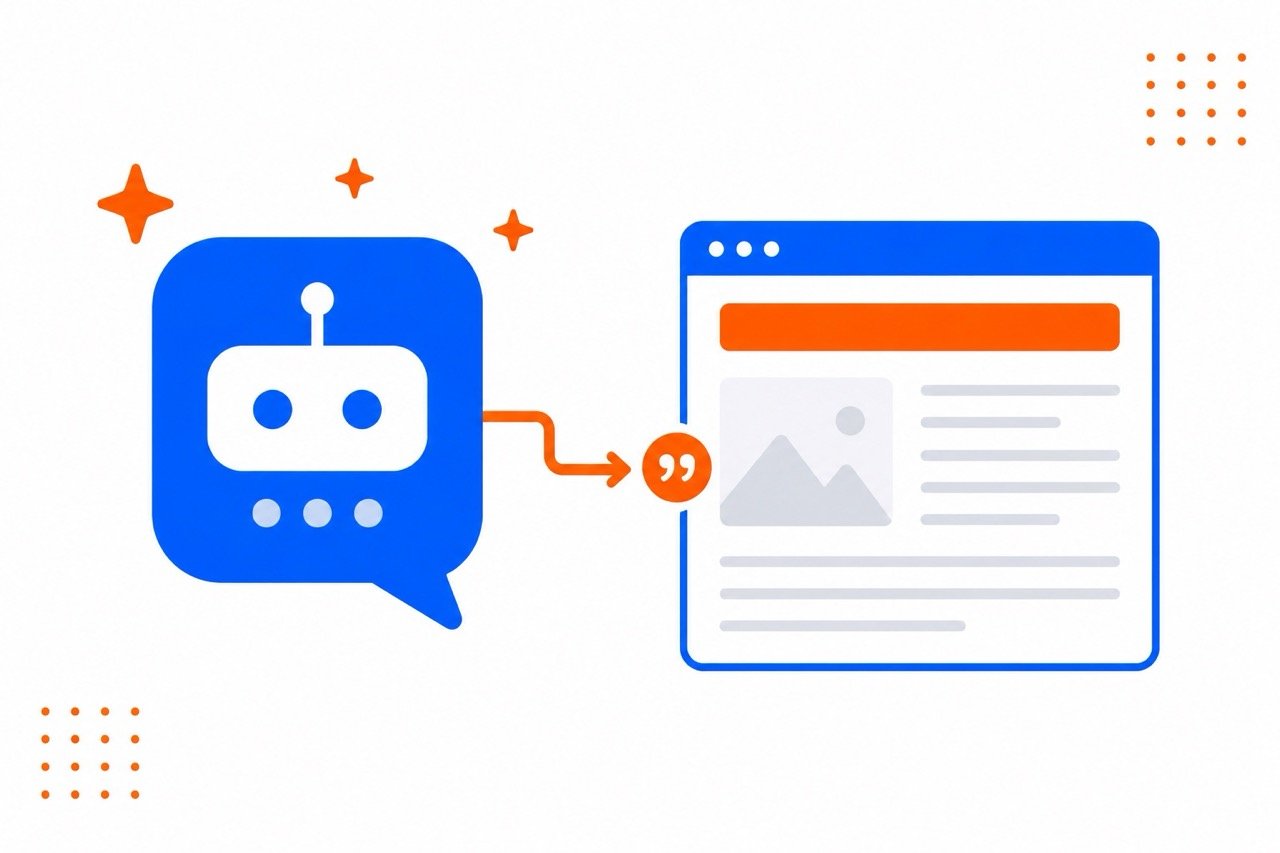
GEO (Generative Engine Optimization) is the practice of making your brand visible and citable inside AI answers — ChatGPT, Perplexity, Claude, Gemini, and Google AI Overviews. It borrows from classical SEO but optimizes for a different mechanic: how LLMs retrieve, trust, and quote sources. In 2026, brands that ignore GEO are losing an increasing share of high-intent queries to competitors who are being cited where the buying decision actually happens.
What GEO actually is
Generative Engine Optimization is the discipline of getting your brand, content, and products included in the answers produced by large language models and AI search tools. Where classical SEO optimizes for a ranked list of blue links, GEO optimizes for a single synthesized answer — one that may or may not name you, link to you, or represent your position accurately.
The shift matters because user behavior has moved. A growing share of queries that used to start on Google now start (and end) inside ChatGPT, Perplexity, Claude, or the AI Overview that sits above the classical results. If you are not part of the answer, you are not part of the consideration set.
Why GEO matters in 2026
Three structural changes have made AI visibility a strategic priority, not an experimental side project:
Classical SEO still drives real traffic, but the ceiling is dropping. The queries that historically converted best — comparisons, “best X for Y”, how-to questions, product research — are exactly the ones most likely to be answered by an AI with no click required. GEO is how you stay in the conversation when the click disappears.
GEO vs. SEO: what actually changes
GEO is not a replacement for SEO. It is a second optimization target layered on top of the same technical foundation. The mechanics diverge where it counts:
| Dimension | Classical SEO | GEO |
|---|---|---|
| Target | Ranked blue links on a SERP | Inclusion in a synthesized AI answer |
| Unit of success | Click to your site | Brand mention, citation, or link inside the answer |
| Content structure | Keyword depth, comprehensiveness | BLUF, clear definitions, extractable facts |
| Authority signal | Backlinks, E-E-A-T, domain strength | Consistent brand mentions across trusted third parties |
| Measurement | Rankings, CTR, organic sessions | Citation rate, share of voice inside AI answers, branded prompt visibility |
| Feedback loop | Weeks to months | Days to weeks — LLM retrieval refreshes faster than Google’s index |
The six pillars of GEO
Every GEO engagement I run is structured around the same six pillars. Miss one and the rest underperform — LLMs aggregate signals, they do not weight them evenly.
BLUF content formatting
Bottom Line Up Front. Lead with the answer in the first two paragraphs. This is where 44% of LLM citations come from.
Extractable structure
Short paragraphs, definition lists, comparison tables, FAQ blocks. Formats LLMs can lift cleanly into an answer.
Structured data & schema
Organization, Person, Product, Article, FAQ, HowTo, and the newer citation schemas. Schema is the most machine-friendly layer of your content.
Citation-worthy facts
Original data, specific numbers, named sources, dated statistics. LLMs preferentially cite content that carries verifiable claims.
Third-party brand mentions
Because brands are cited 6.5× more via external sources than their own site, off-site presence is the single biggest GEO lever.
Technical accessibility for AI crawlers
GPTBot, PerplexityBot, ClaudeBot, Google-Extended — different bots, different rules. Your robots.txt and server-rendered content decide what they actually see.
Pillar 1: BLUF formatting and answer placement
Most content still buries the answer under throat-clearing. LLMs do not tolerate this. When a retrieval system scans your page for a relevant passage, it reads the top first — and if the top does not clearly answer the query, the model pulls from someone who does.
The fix is not mysterious. State the answer in the first paragraph, define the key term in the second, and use the rest to justify, qualify, and expand. This format happens to also perform well for human readers who skim — a rare case where SEO, GEO, and UX all agree.
Pillar 2: Extractable structure
LLMs lift content in chunks. The more your page is built out of self-contained, clearly bounded chunks, the more of it becomes citable. What this looks like in practice:
Structural patterns that get cited
- Short paragraphs (2–4 sentences) with one idea each
- Named definitions introduced in a single sentence (“GEO is …”)
- Comparison tables with clear column headers
- Numbered lists for processes and steps
- Bulleted lists for parallel items and criteria
- FAQ blocks using the actual questions people ask
- Pull quotes with explicit attribution and date
- Bolded key terms at first use, making the phrase easy to extract
Pillar 3: Structured data and schema
Schema markup is the clearest machine-readable signal you can give. LLMs and classical search engines both consume it, and it fills gaps that prose leaves ambiguous. The schemas that matter most for GEO in 2026:
- Organization / LocalBusiness — establishes entity identity, the foundation for brand mentions being resolved to you and not a similarly named entity
- Person — critical for E-E-A-T signals that LLMs increasingly weight when deciding whom to trust
- Article + author + datePublished — freshness and authorship are table stakes for citation
- Product + Offer + Review — drives inclusion in product comparison answers
- FAQPage + HowTo — directly maps to question-shaped prompts
- citation / sameAs — explicit pointers that LLMs use to verify identity and cross-reference sources
Pillar 4: Citation-worthy facts
LLMs are built to produce confident answers, and they preferentially cite content that reduces their uncertainty. That means content with specific numbers, named sources, and clear methodology gets cited more often than content built on vague claims.
Practical ways to become citation-worthy:
- Publish original data from your own work — client results, survey data, internal benchmarks
- Quantify everything you can: “faster” becomes “2.4× faster”; “most” becomes “63%”
- Date your statistics explicitly and update them annually
- Link to primary sources, not aggregators
- Name the researcher, the firm, or the study — generic “studies show” rarely gets picked up
Pillar 5: Third-party brand mentions (the single biggest lever)
This is where most GEO programs fail. Brands are cited 6.5× more often via third-party sources than via their own domain, yet most teams spend 90% of their budget on on-site content. The math is upside down.
What actually moves AI visibility:
- Listicle inclusion — “Best X for Y” articles on trusted publications and niche blogs. LLMs weight these heavily for comparison queries
- Industry directories and review platforms — G2, Clutch, Trustpilot, and vertical equivalents feed both Google and AI retrieval layers
- Podcast appearances and expert roundups — quotes in third-party content that name your brand and role
- Wikipedia and Wikidata — foundational entity establishment, still one of the highest-trust citation sources for LLMs
- Unlinked brand mentions — LLMs often need the mention, not the link; just being named in authoritative content does work
- Original PR and data stories — coverage that positions you as a source, not just a subject
Pillar 6: Technical accessibility for AI crawlers
All the content work in the world fails if the bots cannot read the page. AI crawlers have different identities and different rules than Googlebot:
What I check on the technical side
- robots.txt rules for GPTBot, OAI-SearchBot, PerplexityBot, ClaudeBot, Google-Extended, Bingbot, Applebot-Extended
- Server-rendered content vs. client-side only rendering (many LLM crawlers do not execute JavaScript reliably)
- Canonical tags and hreflang consistency so entity signals do not fragment
- HTTPS, redirect chains, response codes — the same basics classical SEO cares about
- llms.txt implementation, where appropriate, to surface your preferred sources and context
- Accessibility of your content APIs and feeds (RSS, JSON-LD endpoints)
One important call: blocking AI crawlers is a strategic decision, not a default. If your moat is proprietary content, blocking may be correct. If your growth depends on being known, blocking is self-sabotage. I walk clients through this trade-off explicitly rather than applying a one-size-fits-all rule.
Measuring GEO: the tools I actually use
You cannot improve what you cannot see. The measurement stack for GEO is still maturing, but a few tools have become defaults:
The single cheapest thing you can do today: run your 20 most important prompts through ChatGPT, Perplexity, Claude, and Gemini. Record whether your brand appears, how it is described, and which sources are cited instead. That becomes your baseline.
What a GEO engagement looks like
My typical engagement runs in three phases. Each one builds on the last and is measurable in its own right.
- Visibility baseline (week 1) — audit your current presence across the major AI assistants for your target prompts, map who is being cited instead of you, identify quick-win formats.
- Foundation fixes (weeks 2–6) — schema, BLUF rewrites, technical accessibility, citation-worthy content upgrades on your most important pages. Usually where the first visibility lifts appear.
- Off-site amplification (weeks 6+) — directory placements, expert contributions, data PR, listicle inclusion campaigns. This is the compounding work that separates brands that get cited from brands that do not.
Want to see whether AI assistants are recommending you — or your competitors?
I run GEO audits the same way I run classical SEO audits: short, ranked by impact, and tied to outcomes you can measure. No vanity dashboards. Just the work that gets you cited where the buying decision now happens.
Book a free 30-min consultationCommon mistakes I see in DIY GEO
- Treating GEO as a content tweak. Rewriting a few pages with bullet points is not a strategy. Without off-site mentions and entity establishment, it is noise.
- Optimizing for one LLM. ChatGPT, Perplexity, Claude, and Gemini retrieve differently. Winning one does not win the others. Measure all four.
- Blocking AI crawlers by default. “We do not want our content scraped” sounds principled until you realize your competitor’s content is being cited in answers to your branded queries.
- Chasing citation without entity work. If your brand is not clearly disambiguated (Organization schema, Wikidata, consistent NAP, sameAs links), LLMs will struggle to attribute mentions to you at all.
- No baseline, no measurement. If you cannot show that your citation rate moved from X to Y, the project has no narrative and no budget next year.
FAQ
Is GEO just SEO with a new name?
No. GEO shares a technical foundation with SEO — crawlability, schema, content quality — but optimizes for a different outcome. Classical SEO wants a click from a ranked list. GEO wants your brand included in a synthesized answer, often with no click at all. The authority signals, content formats, and measurement methods differ enough that they deserve to be run as distinct disciplines, even when the same person owns both.
How long until I see results from GEO work?
Faster than classical SEO. Because LLM retrieval layers refresh more often than Google’s index, on-site changes can influence AI answers in days to weeks rather than months. Off-site work — directory placements, expert contributions, data PR — compounds over months but also tends to show up in AI citations faster than in classical ranking movements.
Do I need to block or allow AI crawlers?
That is a strategic choice, not a default. If your growth model depends on being known, found, and cited, blocking AI bots is self-sabotage. If your moat is proprietary content and you monetize through subscriptions or direct relationships, blocking may be correct. Most businesses fall firmly in the first category and should allow crawlers while negotiating better attribution norms at the industry level.
How is AI visibility measured?
Primarily through prompt-level tracking: running your priority queries across ChatGPT, Perplexity, Claude, and Gemini at a regular cadence and recording whether your brand appears, how it is described, and which competitors are cited. Tools like Profound, Peec AI, and AthenaHQ automate this. Ahrefs and Semrush have begun adding AI-specific tracking as well. A manual baseline still matters — it keeps you honest about what the tools are actually measuring.
What does a GEO engagement cost?
It depends on scope. A focused visibility audit and priority-page upgrade pass typically runs €1,500–€4,000. Ongoing GEO programs with off-site amplification are structured as monthly retainers scaled to your target prompt set and competitive landscape. The right framing is the cost of absence: if three of your target prompts are currently answered with a competitor’s name, the math usually justifies the spend quickly.
Can I do GEO without doing SEO?
Not well. Most of the technical foundations — crawlability, schema, site structure, authority — are shared. If your site is a mess at the classical SEO layer, the GEO work will underperform because AI retrieval often draws on the same signals and, in many cases, the same index. The practical answer is that GEO sits on top of competent SEO, not in place of it.
Related guides
GEO does not stand alone. These companion pieces cover the rest of the stack:
- SEO Audit in 2026 — the full diagnostic walkthrough across all six SEO pillars.
- Technical SEO in 2026 — crawl, rendering, schema, and the foundations LLM bots need to reach you.
- On-Page SEO in 2026 — the page-level layer where GEO formatting is applied (BLUF, intent, schema).
- Off-Page SEO in 2026 — brand mentions, Reddit citations, digital PR — the off-page side of AI visibility.
- SEO Consultation — advisory work to plan the GEO + SEO roadmap.